
A healthy and well-functioning digestive system is essential for the overall health and welfare of the horse. Abrupt changes to the diet can affect both the function and the balance of the digestive system 1,2. Disruption of this balance may result in health disorders that negatively affect the horse's general health and welfare 3.
The equine digestive system can be divided into two functional sections. In the first section, nutrients are primarily digested through enzymatic processes 4. The second section comprises the small intestine, caecum and large intestine. Within these regions, dietary fibre is fermented by the resident microorganisms into the volatile fatty acids butyrate, acetate and propionate 5. Volatile fatty acids provide approximately 60–70% of the energy required for metabolic processes within the horse's body 6. Consequently, the horse's energy supply depends largely on microbial fermentation of dietary fibre within the hindgut 7.
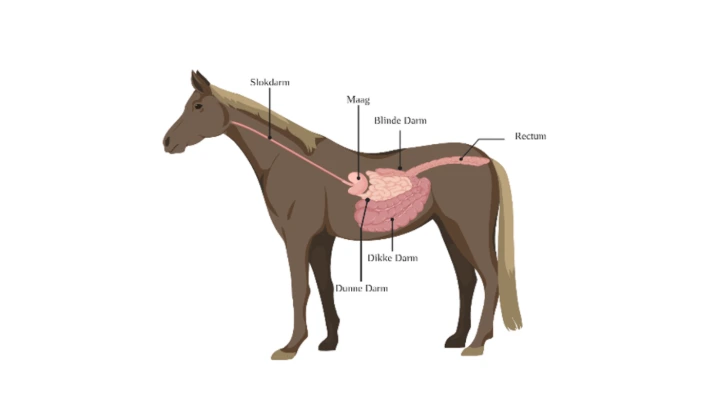
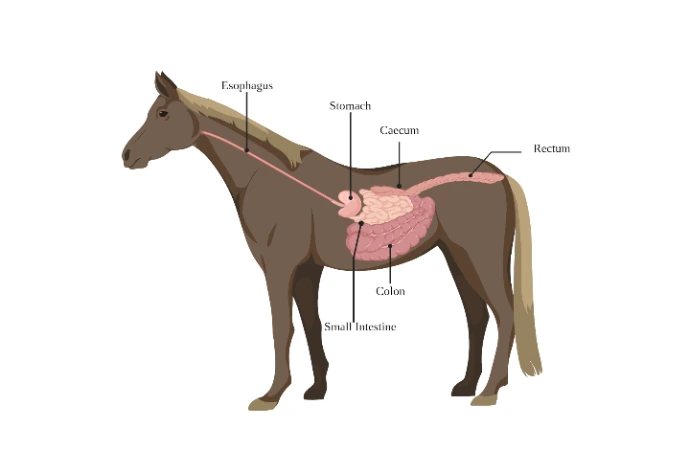
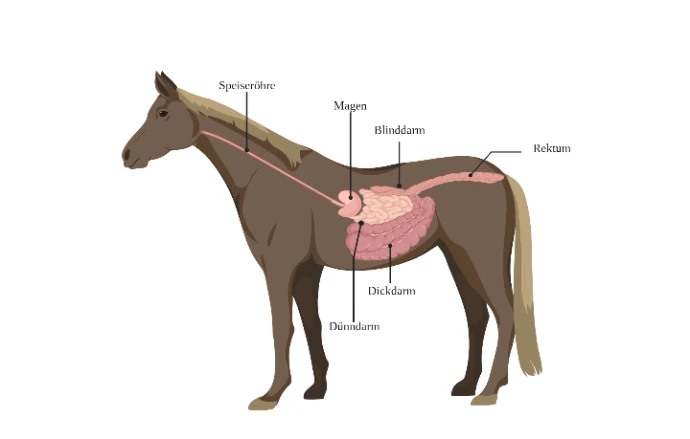
The gastrointestinal tract contains a diverse population of microorganisms, including bacteria, fungi, archaea, protozoa and bacteriophages, each fulfilling specific functions 8. The composition of the gut microbiota influences both volatile fatty acid production and the overall health of the horse 2. This microbial composition is influenced primarily by diet. The fermentation of fibre derived from forage and the subsequent production of volatile fatty acids promote the growth and activity of microorganisms that contribute positively to intestinal function and gut health 9,10.
Abrupt dietary changes or diets containing high levels of sugar and starch can disrupt the balance of the gut microbiota 11. The horse's digestive system has a limited capacity to digest large quantities of starch in the small intestine. When dietary starch intake exceeds this capacity, a proportion of the starch escapes enzymatic digestion and passes into the hindgut, where it undergoes microbial fermentation 12. This alters the activity and efficiency of fibre fermentation 13. Changes in the activity and composition of the gut microbiota can be assessed by measuring faecal pH, lactic acid and volatile fatty acid concentrations 1. Studies have shown that starch fermentation in the hindgut results in increased lactic acid production, leading to a reduction in intestinal pH 11,12. Furthermore, research has demonstrated that this more acidic environment promotes the proliferation of lactic acid-producing bacteria, including species of Streptococcus 11,14. Disturbances in the balance of the gut microbiota, characterised by a reduced pH and increased lactic acid production, have been associated with an increased risk of colic and laminitis in horses 15,16.
Alterations in the gut microbiota may also influence equine behaviour 17,18. Research has shown that changes in the gut microbiota associated with high-starch diets result in increased reactive behaviour 19. In contrast, horses receiving high-fibre diets develop a different microbial composition within the hindgut and generally display calmer behaviour 19.
In summary, a healthy and balanced gut microbiota is essential for maintaining digestive health, overall wellbeing and normal behaviour in horses. It is therefore important to provide a balanced diet that meets the horse's nutritional requirements. In addition, dietary supplements may be used to support gastrointestinal function and help maintain a healthy gut microbiota.
Referenties
- Grimm, P., Philippeau, C., & Julliand, V. (2017). Faecal parameters as biomarkers of the equine hindgut microbial ecosystem under dietary change. Animal, 11(7): 1136-1145.
- Julliand, V., & Grimm, P. (2016). Horse species symposium: The microbiome of the horse hindgut: History and current knowledge. Journal of Animal Science, 94(6): 2262-2274.
- Bland, S. D. (2016). Equine colic: a review of the equine hindgut and colic. Veterinary Science Development, 6(1): 48-51.
- Strauch, S., Wichert, B., Greef, J. M., Hillegeist, D., Zeyner, A., & Liesegang, A. (2017). Evaluation of an in vitro system to simulate equine foregut digestion and the influence of acidity on protein and fructan degradation in the horse′s stomach. Journal of Animal Physiology and Animal Nutrition, 101: 51-58.
- Collinet, A., Grimm, P., Julliand, S., & Julliand, V. (2021). Multidimensional Approach for Investigating the Effects of an Antibiotic–Probiotic Combination on the Equine Hindgut Ecosystem and Microbial Fibrolysis. Frontiers in Microbiology, 12: 1-14.
- Bergman, E. N. (1990). Energy contributions of volatile fatty acids from the gastrointestinal tract in various species. Physiological Reviews, 70(2): 567-590.
- Dougal, K., de la Fuente, G., Harris, P. A., Girdwood, S. E., Pinloche, E., & Newbold, C. J. (2013). Identification of a Core Bacterial Community within the Large Intestine of the Horse. PLoS ONE, 8(10): 1-12.
- Julliand, V., & Grimm, P. (2016). Horse species symposium: The microbiome of the horse hindgut: History and current knowledge. Journal of Animal Science, 94(6): 2262-2274.
- Raspa, F., Vervuert, I., Capucchio, M. T., Colombino, E., Bergero, D., Forte, C., Greppi, M., Cavallarin, L., Giribaldi, M., Antoniazzi, S., Cavallini, D., Valvassori, E., & Valle, E. (2022). A high-starch vs. high-fibre diet: effects on the gut environment of the different intestinal compartments of the horse digestive tract. BMC Veterinary Research, 18(187): 1-11.
- Moore-Colyer, M. J. S., Hyslop, J. J., Longland, A. C., & Cuddeford, D. (2000). Intra-caecal fermentation parameters in ponies fed botanically diverse fibre-based diets. Animal Feed Science and Technology, 84(3–4): 183-197.
- de Fombelle, A., Varloud, M., Goachet, A. G., Jacotot, E., Philippeau, C., Drogoul, C., & Julliand, V. (2003). Characterization of the microbial and biochemical profile of the different segments of the digestive tract in horses given two distinct diets. Animal Science, 77(2): 293-304.
- al Jassim, R. A. M., Scott, P. T., Trebbin, A. L., Trott, D., & Pollitt, C. C. (2005). The genetic diversity of lactic acid producing bacteria in the equine gastrointestinal tract. FEMS Microbiology Letters, 248(1): 75-81.
- Philippeau, C., Sadet-Bourgeteau, S., Varloud, M., & Julliand, V. (2015). Impact of barley form on equine total tract fibre digestibility and colonic microbiota. Animal, 9(12): 1943-1948.
- Park, T., Cheong, H., Yoon, J., Kim, A., Yun, Y., & Unno, T. (2021). Comparison of the fecal microbiota of horses with intestinal disease and their healthy counterparts. Veterinary Sciences, 8(6): 1-10.
- Hudson, J. M., Cohen, N. D., Gibbs, P. G., & Thompson, J. A. (2001). Feeding practices associated with colic in horses. Journal of the American Veterinary Medical Association, 219(10): 1419-1425.
- Cohen, N. D., Gibbs, P. G., & Woods, A. M. (1999). Dietary and other management factors associated with colic in horses. Journal of the American Veterinary Medical Association, 215(1): 53-60.
- Bulmer, L., McBride, S., Williams, K., & Murray, J. A. (2015). The effects of a high-starch or high-fibre diet on equine reactivity and handling behaviour. Applied Animal Behaviour Science, 165: 95-102.
- Destrez, A., Grimm, P., Cézilly, F., & Julliand, V. (2015). Changes of the hindgut microbiota due to high-starch diet can be associated with behavioral stress response in horses. Physiology and Behavior, 149: 159-164.
- Bulmer, L. S., Murray, J. A., Burns, N. M., Garber, A., Wemelsfelder, F., McEwan, N. R., & Hastie, P. M. (2019). High-starch diets alter equine faecal microbiota and increase behavioural reactivity. Scientific Reports, 9(1): 1-11.