The Horse’s Muscles: Everything About Muscle Development, Muscle Recovery and Nutrition
A horse’s muscles enable the horse to perform movements more easily during exercise, carry the rider’s weight, protect the joints and support the tendons and ligaments. A healthy and strong muscle mass is therefore essential for the horse’s health and performance. To build and maintain strong muscle mass, training and proper nutrition are essential.
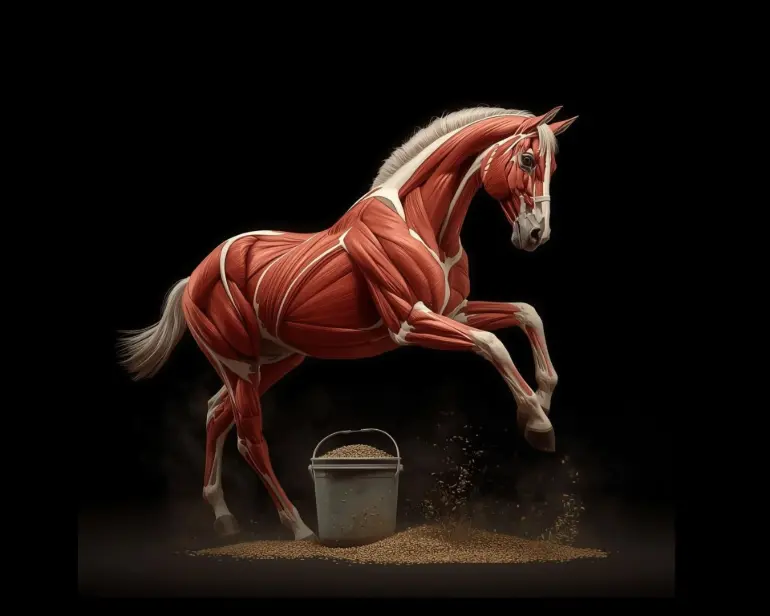
A horse’s muscles enable the horse to perform movements more easily during exercise, carry the rider’s weight, protect the joints and support the tendons and ligaments. A healthy and strong muscle mass is therefore essential for the horse’s health and performance. To build and maintain strong muscle mass, training and proper nutrition are essential.
The Horse’s Muscles
The horse’s body consists of more than 700 muscles. In athletic horses, such as Thoroughbreds, more than 50% of bodyweight consists of skeletal muscles¹. The different muscles each have their own function and contribute to movement and stability of the body. Muscles are made up of various muscle fibres, and these fibres are composed of proteins. These proteins are responsible for the contraction and relaxation of the muscles². This contraction and relaxation is what enables bodily movement.
There are two types of muscle fibres: type 1 and type 2 fibres². Type 1 fibres are also known as slow-twitch fibres. They contract slowly, require little force and therefore do not fatigue quickly. Type 2 fibres contract quickly and are strong.
The number of muscle cells a horse has is genetically determined. Training increases muscle mass and improves muscular stamina. Proper nutrition provides the building blocks for muscle development and supports the maintenance of strong, healthy muscles.
Nutrition and Training for Muscle Development and Maintenance
Proteins and Amino Acids
For the synthesis of muscle proteins, which are important for muscle building and muscle repair, amino acids are required³. Dietary proteins consist of various amino acids, making an adequate protein intake essential for the horse. Research has shown that feeding sufficient protein, resulting in increased concentrations of available amino acids in the body, stimulates muscle protein synthesis⁴.
There are two types of amino acids: essential and non-essential amino acids³. Essential amino acids cannot be produced by the horse and must be supplied through the diet. Non-essential amino acids can be produced by the horse’s body itself.
Energy
For optimal muscle development, maintenance and repair, energy is also required. Enough energy in the body provides the muscles with the fuel needed for movement. Horses obtain energy from carbohydrates and fats. There are two forms of energy: short-term and long-term. Carbohydrates such as starch and sugar are rapidly converted into energy and are therefore quickly available. Fats are converted more slowly, providing a long-lasting energy source. Both forms are important for the muscles and the different types of muscle fibres. Energy is required for all metabolic processes in the body; therefore, if energy is lacking, muscle protein synthesis decreases and muscle breakdown increases⁵. This means that providing sufficient protein alone is not enough for optimal muscle development and recovery, energy is also a key nutrient for the muscles. Supplements such as linseed oil provide the horse with additional fatty acids and thus extra energy to support muscle development. If muscle development remains insufficient despite adequate protein intake, it is advisable to add linseed oil to the diet to supply extra energy.
Gamma-Oryzanol
When the diet contains insufficient protein, proteins or amino acids can be added through supplementation. Nutrients such as gamma-oryzanol can also support and promote muscle development and post-exercise recovery. Research shows that supplementation with gamma-oryzanol promotes muscle development by increasing muscle strength⁶. In addition, gamma-oryzanol functions as an antioxidant, supporting muscle recovery after exercise and reducing muscle fatigue⁷. Synovium Myobuilder and Synovium Megabol both contain gamma-oryzanol to support muscle development in horses.
Training
Not only nutrition influences muscle protein synthesis and thus the development and repair of muscle mass, but training also plays a major role. Muscles are continuously being built up and broken down. It is important to maintain a balance between muscle protein synthesis and breakdown to promote muscle development and repair. Training and movement stimulate synthesis in the body and therefore promote muscle development⁸. With little or no exercise, muscle breakdown will exceed synthesis, preventing muscle development. Therefore, alongside adequate nutrients in the diet, it is crucial that horses exercise and are trained for optimal muscle development.
Nutrition for Muscle Recovery
Following intensive muscle exertion, specific nutrients, alongside energy and protein, provide additional support for muscle recovery.
Antioxidants
During intensive exercise, oxygen supply to the muscles increases⁹. During very intense exertion, oxidative stress can occur. This leads to an imbalance between the number of free radicals and antioxidants in the body⁹ ¹⁰. At that point, more free radicals are released. Excessive amounts of free radicals can cause muscle damage and muscle fatigue¹⁰. Adding antioxidants to the feed helps neutralise free radicals and prevent muscle damage, thereby supporting muscle recovery after intense exercise. Common antioxidants used for muscle recovery include vitamin E, vitamin C and MSM.
Support Against Acidosis
During very intensive muscle exertion, the body may not have enough oxygen available to produce energy. As a result, more lactic acid is produced in the muscles, causing the pH to drop and leading to acidosis¹¹. Acidosis results in faster muscle fatigue and muscle stiffness, negatively affecting the horse’s movement and performance.
To support post-exercise recovery and promote the breakdown of lactic acid in the muscles, supplements such as Synovium Neutravet and Synovium Lactaplus (paste or powder) can be used. By stimulating the removal of lactic acid, muscle stiffness is reduced and recovery is accelerated.
All in all, a balanced diet in combination with training is essential for developing strong muscle mass. When muscle development remains insufficient and it is unclear how the diet should be adjusted to provide optimal support for the horse, it is advisable to consult a nutritionist.
References
1. Rivero, J.L. (2016) Skeletal muscle adaptations and muscle genomics of performance horses. The Veterinary Journal, 209:5-13.
2. Exeter, D., Connell, D.A. (2010) Skeletal Muscle: Functional Anatomy and Pathophysiology. Seminars in Musculoskeletal Radiology, 4(2):97-105.
3. Li, G., Li, Z., Liu, J. (2024) Amino acids regulating skeletal muscle metabolism: mechanisms of action, physical training dosage recommendations and adverse effects. Nutrition and Metabolism, 21(41):1-14.
4. Wilson, F.A., Suryawan, A., Orellana, R.A., Kimball, S.R., Gazzaneo, M.C., Nguyen, H.V., Fiorotto, M.L., Davis, T.A. (2009) Feeding Rapidly Stimulates Protein Synthesis in Skeletal Muscle of Neonatal Pigs by Enhancing Translation Initiation. The Journal of Nutrition, 139(10):1873-1880.
5. Urschel, K.L., McKenzie, EC. (2021) Nutritional Influences on Skeletal Muscle and Muscular Disease. Veterinary Clinics of North America: Equine Practice, 37(1):139-175.
6. Ahn, J., Son, H.J., Seo, H.D., Ha, T.Y., Ahn, J., Lee, H., Shin, S.H., Jung, C.H., Jang, Y.J. (2021) γ-Oryzanol Improves Exercise Endurance and Muscle Strength by Upregulating PPARδ and ERRγ Activity in Aged Mice. Molecular Nutrition & Food Research, 65(14):1-11.
7. Ramazani, E., Akaberi, M., Emami, S.A., Tayarani-Najaran, Z. (2021) Biological and Pharmacological Effects of Gamma-oryzanol: An Updated Review of the Molecular Mechanisms. Current Pharmaceutical Design, 27(19):2299-2316.
8. Loos ,C.M.M., McLeod, K.R., Stratton, S.C., van Doorn, D.A., Kalmar, I.D., Vanzant, E.S., Urschel, K.L. (2020) Pathways regulating equine skeletal muscle protein synthesis respond in a dose-dependent manner to graded levels of protein intake. Journal of Animal Science, 98(9):1-8.
9. Kinnunen, S., Atalay, M., Hyyppä, S., Lehmuskero, A., Hänninen, O., Oksala, N. (2005) Effects of Prolonged Exercise on Oxidative Stress and Antioxidant Defense in Endurance Horses. Journal of Sports Science and Medicine, 4:415-421.
10. Williams, C.A. (2016) The effect of oxidative stress during exercise in the horse. Journal of Animal Science, 94(10):4067-4075.
11. Bartoloni, B., Mannelli, M., Gamberi, T., Fiaschi, T. (2024) The Multiple Roles of Lactate in the Skeletal Muscle. Cells, 13(1177):1-11.
The Horse’s Muscles
The horse’s body consists of more than 700 muscles. In athletic horses, such as Thoroughbreds, more than 50% of bodyweight consists of skeletal muscles¹. The different muscles each have their own function and contribute to movement and stability of the body. Muscles are made up of various muscle fibres, and these fibres are composed of proteins. These proteins are responsible for the contraction and relaxation of the muscles². This contraction and relaxation is what enables bodily movement.
There are two types of muscle fibres: type 1 and type 2 fibres². Type 1 fibres are also known as slow-twitch fibres. They contract slowly, require little force and therefore do not fatigue quickly. Type 2 fibres contract quickly and are strong.
The number of muscle cells a horse has is genetically determined. Training increases muscle mass and improves muscular stamina. Proper nutrition provides the building blocks for muscle development and supports the maintenance of strong, healthy muscles.
Nutrition and Training for Muscle Development and Maintenance
Proteins and Amino Acids
For the synthesis of muscle proteins, which are important for muscle building and muscle repair, amino acids are required³. Dietary proteins consist of various amino acids, making an adequate protein intake essential for the horse. Research has shown that feeding sufficient protein, resulting in increased concentrations of available amino acids in the body, stimulates muscle protein synthesis⁴.
There are two types of amino acids: essential and non-essential amino acids³. Essential amino acids cannot be produced by the horse and must be supplied through the diet. Non-essential amino acids can be produced by the horse’s body itself.
Energy
Voor optimale spieropbouw, onderhoud en herstel is ook energie nodig. Voldoende energie in het lichaam biedt de spieren een vorm van brandstof die nodig is voor beweging. Energie neemt het paard op uit koolhydraten en vetten. Er zijn twee vormen van energie. Kortdurende energie en langdurige energie. Koolhydraten zoals zetmeel en suiker worden snel in het lichaam omgezet tot energie en zijn daardoor snel beschikbaar als energiebron. Vetten worden langzaam omgezet, waardoor het een langdurige bron van energie biedt. Beiden vormen van energie zijn belangrijk voor de spieren en de verschillende type spiervezels. Energie is nodig voor alle metabolische processen in het lichaam, dus bij een energie tekort zal de spiereiwitsynthese in het lichaam afnemen en de spier afbraak toenemen 5. Daarom is het voeren van voldoende eiwitten niet genoeg voor optimale spieropbouw en herstel, maar is ook energie een belangrijke voedingstof voor de spieren. Supplementen zoals Lijnzaadolie bieden het paard extra vetzuren en daarmee energie om spieropbouw te ondersteunen. Wanneer spieropbouw uitblijft, ookal biedt het rantsoen voldoende eiwitten, is het aan te raden om Lijnzaadolie aan het rantsoen toe te voegen om het paard van extra energie te voorzien.
Gamma-Oryzanol
Wanneer het rantsoen onvoldoende eiwitten bevat, kunnen eiwitten of aminozuren worden aangevuld via supplementen. Ook voedingsstoffen zoals Gamma-Oryzanol ondersteunen en bevorderen de spieropbouw en herstel na inspanning. Onderzoek toont aan dat supplementatie van Gamma-Oryzanol de spier opbouw bevordert door spierkracht te bevorderen 6. Daarnaast werkt Gamma-Oryzanol als antioxidant waardoor het herstel van de spieren ondersteunt na inspanning en vermindert het spiervermoeidheid 7. Synovium Myobuilder en Synovium Megabol bevatten daarom beiden Gamma-Oryzanol ter ondersteuning van de spieropbouw van het paard.
Training
Not only nutrition influences muscle protein synthesis and thus the development and repair of muscle mass, but training also plays a major role. Muscles are continuously being built up and broken down. It is important to maintain a balance between muscle protein synthesis and breakdown to promote muscle development and repair. Training and movement stimulate synthesis in the body and therefore promote muscle development⁸. With little or no exercise, muscle breakdown will exceed synthesis, preventing muscle development. Therefore, alongside adequate nutrients in the diet, it is crucial that horses exercise and are trained for optimal muscle development.
Nutrition for Muscle Recovery
Following intensive muscle exertion, specific nutrients, alongside energy and protein, provide additional support for muscle recovery.
Antioxidants
Tijdens intensieve inspanning neemt de toevoer van zuurstof naar de spieren toe 9. Bij zeer intensieve inspanning ontstaat er oxidatieve stress. Dit zorgt ervoor dat er een disbalans ontstaat tussen de hoeveelheid vrije radicalen en antioxidanten in het lichaam 9,10. Er komen op dat moment meer vrije radicalen vrij in het lichaam. Een te hoge hoeveelheid vrije radicalen kan resulteren in spierschade en spiervermoeidheid 10. Toevoeging van antioxidanten aan het voer, zorgen ervoor dat de vrije radicalen worden geneutraliseerd en spierschade wordt voorkomen. Hierdoor bevorderen ze herstel van de spieren na intensieve inspanning. Een aantal antioxidanten die vaak bijgevoerd worden ter bevordering van spierherstel zijn vitamine E, vitamine C en MSM.
Support Against Acidosis
During very intensive muscle exertion, the body may not have enough oxygen available to produce energy. As a result, more lactic acid is produced in the muscles, causing the pH to drop and leading to acidosis¹¹. Acidosis results in faster muscle fatigue and muscle stiffness, negatively affecting the horse’s movement and performance.
Om het herstel na inspanning te ondersteunen en de afbraak van melkzuur in de spieren te bevorderen, kunnen supplementen zoals Synovium Neutravet en Synovium Lactaplus (pasta of poeder) worden gebruikt. Door de afvoer van melkzuur te stimuleren, wordt spierstijfheid verminderd en herstel versneld.
All in all, a balanced diet in combination with training is essential for developing strong muscle mass. When muscle development remains insufficient and it is unclear how the diet should be adjusted to provide optimal support for the horse, it is advisable to consult a nutritionist.
References
1. Rivero, J.L. (2016) Skeletal muscle adaptations and muscle genomics of performance horses. The Veterinary Journal, 209:5-13.
2. Exeter, D., Connell, D.A. (2010) Skeletal Muscle: Functional Anatomy and Pathophysiology. Seminars in Musculoskeletal Radiology, 4(2):97-105.
3. Li, G., Li, Z., Liu, J. (2024) Amino acids regulating skeletal muscle metabolism: mechanisms of action, physical training dosage recommendations and adverse effects. Nutrition and Metabolism, 21(41):1-14.
4. Wilson, F.A., Suryawan, A., Orellana, R.A., Kimball, S.R., Gazzaneo, M.C., Nguyen, H.V., Fiorotto, M.L., Davis, T.A. (2009) Feeding Rapidly Stimulates Protein Synthesis in Skeletal Muscle of Neonatal Pigs by Enhancing Translation Initiation. The Journal of Nutrition, 139(10):1873-1880.
5. Urschel, K.L., McKenzie, EC. (2021) Nutritional Influences on Skeletal Muscle and Muscular Disease. Veterinary Clinics of North America: Equine Practice, 37(1):139-175.
6. Ahn, J., Son, H.J., Seo, H.D., Ha, T.Y., Ahn, J., Lee, H., Shin, S.H., Jung, C.H., Jang, Y.J. (2021) γ-Oryzanol Improves Exercise Endurance and Muscle Strength by Upregulating PPARδ and ERRγ Activity in Aged Mice. Molecular Nutrition & Food Research, 65(14):1-11.
7. Ramazani, E., Akaberi, M., Emami, S.A., Tayarani-Najaran, Z. (2021) Biological and Pharmacological Effects of Gamma-oryzanol: An Updated Review of the Molecular Mechanisms. Current Pharmaceutical Design, 27(19):2299-2316.
8. Loos ,C.M.M., McLeod, K.R., Stratton, S.C., van Doorn, D.A., Kalmar, I.D., Vanzant, E.S., Urschel, K.L. (2020) Pathways regulating equine skeletal muscle protein synthesis respond in a dose-dependent manner to graded levels of protein intake. Journal of Animal Science, 98(9):1-8.
9. Kinnunen, S., Atalay, M., Hyyppä, S., Lehmuskero, A., Hänninen, O., Oksala, N. (2005) Effects of Prolonged Exercise on Oxidative Stress and Antioxidant Defense in Endurance Horses. Journal of Sports Science and Medicine, 4:415-421.
10. Williams, C.A. (2016) The effect of oxidative stress during exercise in the horse. Journal of Animal Science, 94(10):4067-4075.
11. Bartoloni, B., Mannelli, M., Gamberi, T., Fiaschi, T. (2024) The Multiple Roles of Lactate in the Skeletal Muscle. Cells, 13(1177):1-11.